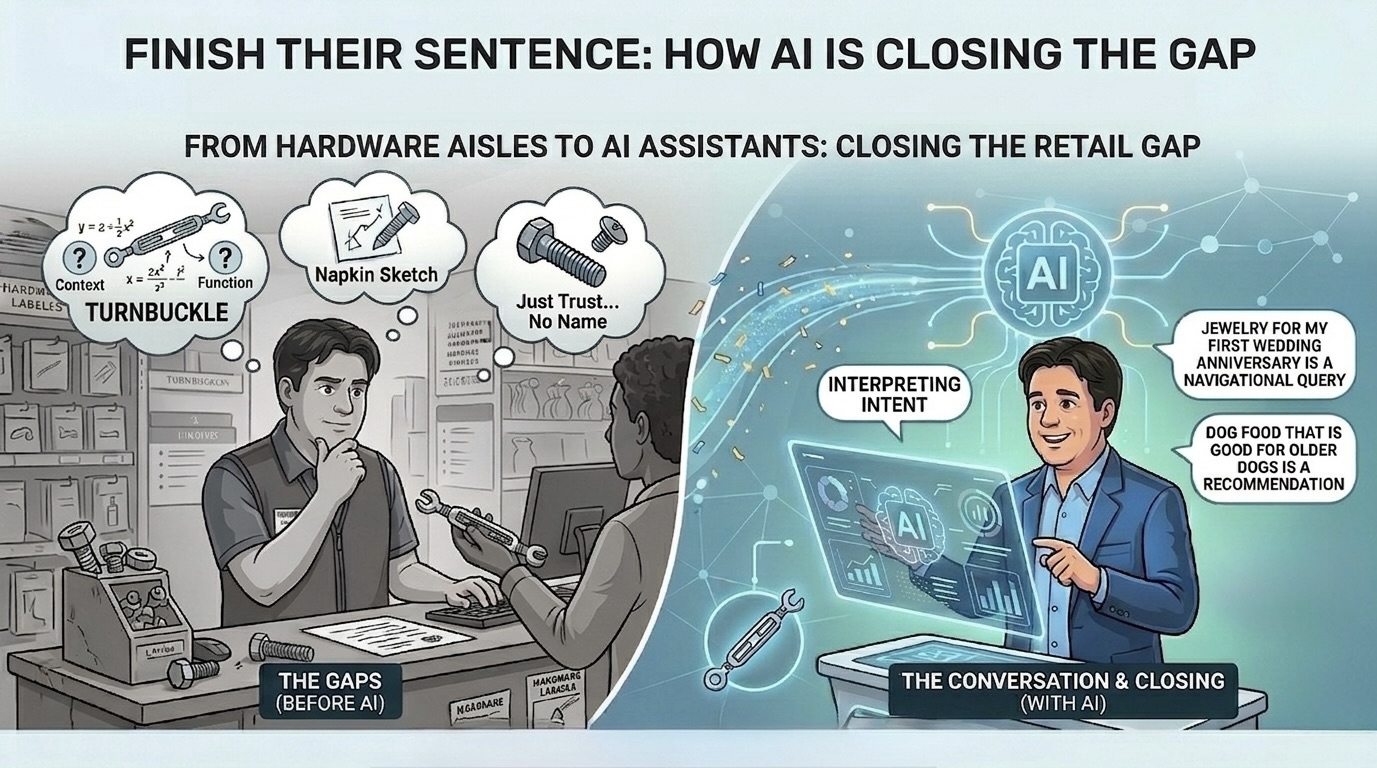
Early in my retail career I managed the hardware department in a Lowe’s store. It was an education unlike anything I had experienced before. Customers would walk in and describe what they needed using whatever words felt right to them. This could be a vague physical description, a rough sketch on a napkin, or sometimes just a hand extended with a bolt, screw, or fitting and the expectation that I would figure it out. No product name. No SKU. Just trust that the person behind the counter would understand. They knew what they wanted but they just couldn’t find it.
To do that job well I had to learn the department the way an AI model learns a dataset by crawling through every aisle, every drawer, thousands of different items for dozens of different purposes. Eventually I knew what things were called, what they did, and how to connect what the customer needed to exactly the right product. I had never heard the word “turnbuckle” before I worked in that department. To this day I still remember exactly what it looked like and how they were used.
That experience helped shape how I thought about eCommerce for the next fifteen years. When I moved from the store floor to digital commerce, I kept running into the same fundamental problem: the online experience had no equivalent of the associate behind the counter. Customers had to know exactly what they were looking for before the site could help them find it. Try searching for “that thing for my fence” on a site search bar and see how helpful the results are. Customers are increasingly communicating with websites the same way they do with people. More conversational, less keyword centric.
The Long Tail Was Telling Us Something
The shift from keyword to conversational search didn’t begin with ChatGPT. It began years earlier, quietly, in the data. When I was managing eCommerce categories at PetSmart, I started noticing searches like “dog food that is good for older dogs” appearing alongside the more familiar “dog food.” At JCPenney I would see terms like “inexpensive women’s engagement ring” or “jewelry for my first wedding anniversary.” The volume on those longer queries was always lower, the specificity of the language made them rarer by nature, but collectively they were growing steadily year over year. Much like the river of slime in Ghostbusters 2, something was building beneath the surface and nobody was paying attention.
Those terms communicated intent in a way that one or two term searches never did. The customer searching “jewelry for my first wedding anniversary” didn’t know what they wanted to buy. They were looking for help. A special occasion coming and they didn’t know what to do about it. They needed a knowledgeable partner to help them figure it out, the digital equivalent of the associate who asks a few questions and guides you to the right items.
The eCommerce product discovery tools of that era were not built for that conversation. In fact, many platforms would truncate long queries after a certain character limit, so “dog food that is good for older dogs” might only be indexed as “dog food that is good.” The results returned were generic. Conversion rates on those terms were low and exit rates were high. Some customers would search again or attempt to filter their way to the right product. Most just left. When someone is standing in a store and can’t find what they need, leaving requires real effort. They have to physically get back in their vehicles and drive somewhere else. Online, switching requires almost no effort. Type a competitor’s URL and off they go. The cost of a failed search experience is paid immediately. Lost traffic, lost revenue, and no guarantee the customer will ever return.
What Customers Have Always Expected
One thing I think often gets missed in conversations about AI and eCommerce product discovery: customers’ expectations haven’t really changed that significantly. They have always wanted to be able to describe their needs and be served results that match. They have always wanted the retailer to finish their sentences. The technology simply wasn’t capable of scalably meeting that expectation until recently.
When a customer walked into my hardware department and held up a bolt, they weren’t being difficult. They were communicating as efficiently as they knew how. It was my job to bridge the gap between their language and the product. That responsibility has always been with the retailer, online or offline. The question was never whether customers should learn to search differently. It was whether retailers would find a way to meet them where they were.
Adobe’s research put numbers to what practitioners had long suspected. Their survey of 5,000 U.S. consumers found that 38% have already used generative AI for online shopping, with 52% planning to do so this year. The most common use? Product research, cited by 53% of AI shoppers. Perhaps more telling, Adobe’s 2026 Digital Trends report found that roughly a quarter of consumers now cite AI-powered platforms like ChatGPT as their top research tool, making them more popular than brand websites and online reviews combined.
How AI Is Closing the Gap
What AI-powered search and discovery tools are doing is exactly what a well-trained store associate does. They interpret intent rather than matching keywords. Understanding that “jewelry for my first wedding anniversary” is a navigational query that requires context, not just a product list. They recognize that “dog food that is good for older dogs” is asking for a recommendation, not a long list of dog food options.
The commercial impact is becoming clear. Visitors who arrive at retail sites via AI-powered discovery are converting at 4.4 times the rate of visitors from traditional organic search, according to Semrush. Shoppers who engage with AI chat on eCommerce sites complete purchases 47% faster. And traffic to U.S. retail sites from generative AI sources grew 4,700% year-over-year in July 2025, a figure that signals not just a trend but a fundamental shift in how product discovery begins.
The gap between what customers want and what retailers have been able to deliver is finally closing. The retailers moving fastest are the ones worth watching.
What Leading Retailers Are Actually Doing
The Home Depot, a company I know well from my years working with their professional and B2B operations, is one of the clearest examples of where this is heading. Announced at NRF 2026 in partnership with Google Cloud, their Magic Apron assistant has been transformed from a simple AI tool on product pages into a conversational expert companion for both DIYers and professional contractors. Customers can now describe projects in plain language and receive expert advice and personalized product recommendations, covering everything from fixing a leaky faucet to planning a full kitchen remodel. For the professional customer, who shops at The Home Depot an average of 60 times per year, the AI-powered Materials List Builder allows pros to create actionable job lists in minutes using natural language, voice-to-text, or spreadsheet uploads. As one contractor put it, “We’ve done multiple takeoffs with The Home Depot and have seen them improve every single time.” The Home Depot currently offers more than a dozen AI-powered capabilities, with numerous others in development, all built around the same principle: meeting the customer where they are, in the language they naturally use.
The Home Depot is not alone. Amazon’s Rufus, Walmart’s Sparky, and a growing number of retailer-built AI assistants are all attempting the same thing: replacing the keyword box with a conversation. The retailers succeeding are those treating AI not as a search upgrade but as a fundamental rethinking of how customers navigate from need to purchase.
What Retailers Need to Get Right
Technology is only part of the equation. The reason my hardware department expertise was useful wasn’t just that I had memorized the inventory, it was that the inventory was well-organized, well-labeled, and structured in a way that made it possible to find things. An AI model is only as good as the product data, content, and taxonomy it has to work with.
Retailers who invest in AI-powered search without investing in the underlying product data infrastructure will find their results disappointing. If a product doesn’t have rich attribute data like material, use case, compatibility, size, and intended audience then no AI model can reliably surface it in response to a conversational query. The question “what dog food is good for older dogs” requires the catalog to contain products tagged for life stage, health condition, and ingredient profile. Without that, the AI has nothing to work with. The most well-designed car in history won’t do much good without the roads, fuel stations, and traffic signals necessary for it to function.
The other thing retailers must get right is trust. There is a significant perception gap worth noting: Deloitte’s 2024 personalization study found that while 92% of retailers believe they effectively offer personalized experiences, only 48% of consumers agreed. The gap between how retailers see themselves and how customers actually experience them is where the real work lies. Closing it requires not just better algorithms but better judgment about when personalization feels helpful versus when it feels intrusive. Melissa Minkow, director of retail strategy at CI&T, made this point well in a Modern Retail interview: “The one thing retailers have to be careful of is the FOMO of it. If customers think you’re skipping on showing them too many items, they’ll worry that they’re not getting the full shopping experience.”
The Bottom Line
The customer who walked into my hardware department and held up a bolt wasn’t asking for much. They just wanted someone to understand what they needed and help them find it. That has always been the job. For most of eCommerce’s history, the technology wasn’t up to it. AI is changing that.
The retailers who will win the next decade of digital commerce are not the ones with the biggest catalogs or the most aggressive paid search budgets. They are the ones who figure out how to finish their customers’ sentences. The ones who don’t will find their customers finishing sentences with a competitor instead.
A Note on Data Privacy
AI-powered personalization and conversational search rely on customer data to deliver relevant experiences. Any implementation should be evaluated carefully against your company’s data privacy and security policies, applicable regulations, and customer consent frameworks. The opportunity to better serve customers is real, so is the responsibility to handle their data with care.
Sources & Further Reading
• Adobe, Digital Insights AI Shopping Report & AI and Digital Trends Report, 2025–2026 — Survey of 5,000 U.S. consumers finding 38% have used generative AI for shopping (52% plan to this year); roughly a quarter now cite AI platforms as their top research tool, ahead of brand websites and online reviews.
• Semrush / Adobe / Brightedge, AI Ecommerce Traffic and Conversion Data, 2025 — AI-referred visitors convert at 4.4x the rate of traditional organic search visitors; U.S. retail site traffic from generative AI grew 4,700% year-over-year in July 2025.
• Rep AI, Ecommerce Shopper Behavior Report, 2025 — Shoppers complete purchases 47% faster when assisted by AI; AI-engaged shoppers convert at 12.3% versus 3.1% for non-AI sessions.
• The Home Depot / Google Cloud, NRF 2026 Announcement & AI at The Home Depot: A Look at the Future of Home Improvement, January–March 2026 — Details on the Magic Apron conversational AI assistant, the AI-powered Materials List Builder for professional contractors, and The Home Depot’s broader suite of more than a dozen AI-powered customer and associate capabilities.
• Deloitte, Personalizing Growth: It’s a Value Exchange Between Brands and Customers, 2024 — Finding that 92% of retailers believe they effectively offer personalized experiences while only 48% of consumers agree — a 44-point perception gap.
• Baymard Institute, Cart Abandonment Research, 2025 — Global cart abandonment rate of 70.19%; $260 billion in recoverable lost orders in the U.S. and EU through improved shopping experiences.
• Modern Retail / Allison Smith, Lowe’s Wants to Roll Out Personalized Website to All Customers by End of 2026, March 2026 — Source for the Melissa Minkow / CI&T quote on personalization and the customer FOMO concern around curated experiences.

Leave a Reply